Livora Gracely

Writing to remember, sharing to inspire

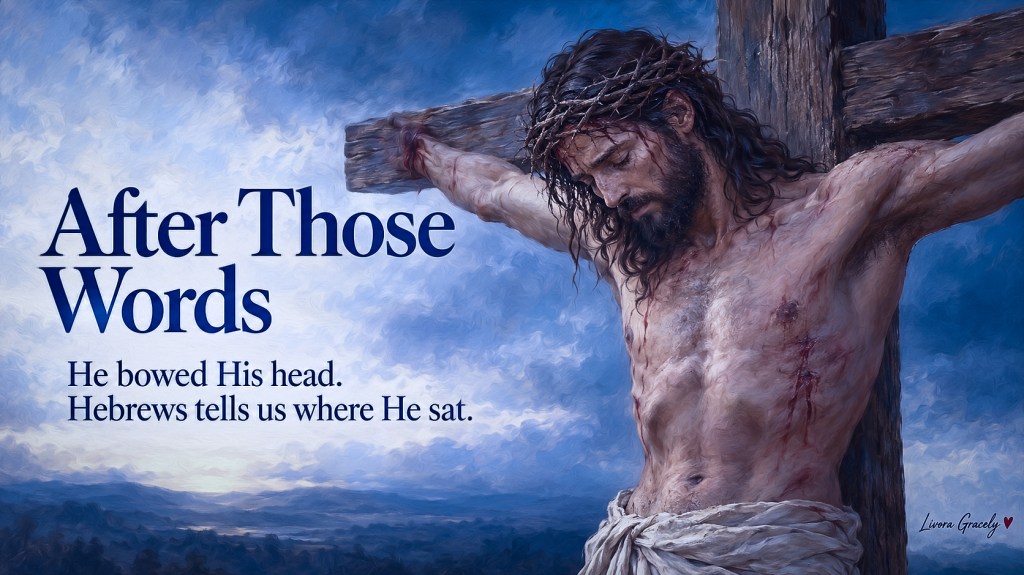
  • He bowed His head. Hebrews tells us where He sat.


    The sharp smell of sour wine rose from a jar beside the cross. A sponge was soaked, placed on a stalk of hyssop, and lifted to Jesus’ lips. He had asked for a drink.

    After receiving it, He spoke:

    “It is finished.”

    Then He bowed His head and gave up His spirit (John 19:28–30).

    The words came from someone who had known thirst and suffering in His own body. Hebrews brings us to the same Son, already described as the radiance of God’s glory and the One who sustains all things. Now its sentence turns toward what He has done about sin:

    “After he had provided purification for sins, he sat down at the right hand of the Majesty in heaven.” — Hebrews 1:3, NIV

    Purification Provided

    Purification is a word for cleansing. Here, the need for it concerns sins.

    The sentence takes human wrongdoing seriously. Something must be dealt with in the relationship between people and the holy God whom the Son reveals. Knowing more about God cannot by itself remove the guilt of turning away from Him. Hebrews names a need that reaches deeper than understanding.

    It also names the One who has acted. The Son provided purification. The One through whom God speaks has entered the work of cleansing those who need to approach Him.

    Later, Hebrews explains how: Christ offered Himself to God. His blood cleanses the conscience so that people may serve the living God (Hebrews 9:14). The offering involves His own life, and its purpose reaches into the person who receives its cleansing.

    At the cross, the drink touched the lips of the One giving that life. His thirst was real. So was the self-giving that Hebrews would describe.

    The letter places purification before us as something He has accomplished. Its opening gives the reader this foundation before unfolding the priesthood, sacrifices, and covenant through which the depth of His work will become clearer.

    He Sat Down

    The small word after gives the sentence its order. Purification has been provided; then the Son sits down.

    Hebrews later makes the significance of this posture clear. The priests stand at their duties, offering the same sacrifices repeatedly. Christ offers one sacrifice for sins and sits at God’s right hand (Hebrews 10:11–14). The repeated work of the former arrangement stands beside the completeness of His offering.

    His sitting expresses something about what has been done. The sacrifice has reached its purpose. There is no further offering of Himself required to complete it.

    The words spoken at the cross return here with greater weight. Jesus gave His life declaring the completion of His work. Hebrews describes the sufficiency of His sacrifice and the posture that follows it.

    This does not mean that His people have already reached the end of their growth. The same passage speaks of those who are being made holy. Their lives continue to be changed upon the foundation of His completed offering.

    Nor does sitting mean His concern for them has ended. Hebrews will show Him serving as their living High Priest. The offering is complete, and the One who offered it remains.

    The Right Hand

    The Son’s seat is at the right hand of the Majesty.

    Majesty names God with reverence. The phrase keeps the Father and the Son before us: the Son sits at God’s right hand, in the place of honour and royal authority.

    Psalm 110:1 stands behind these words. There, the Lord appoints a place at His right hand while enemies are brought beneath the feet of the one seated beside Him. Hebrews draws upon that royal promise to describe the Son’s exaltation.

    The language gives us the meaning of His position. He shares in God’s rule. The One whose sacrifice cleanses His people is also the One who reigns.

    This gathers the earlier descriptions into a fuller picture. God has spoken through the Son, made the universe through Him, and appointed Him heir of all things. The Son sustains creation and has provided purification for sins. His place at the right hand belongs within that immense account of who He is and what He has done.

    The head that bowed at the cross belongs to this Son. His suffering remains part of His story as Hebrews speaks of His honour. The letter’s great High Priest is the very One who gave Himself.

    In Heaven

    The sentence ends by telling us where He sits: in heaven.

    These words carry the account into God’s presence. The Son’s work on earth has its outcome there, where Hebrews locates His royal seat and His continuing priestly service.

    Later, the letter says that Christ entered heaven itself to appear for us before God (Hebrews 9:24). The One who provided purification is present on behalf of those who depend upon Him. His ministry reaches the place their own efforts could never secure for them.

    Hebrews 8:1–2 brings the two truths together. Our High Priest sits at the right hand of the heavenly throne, and He serves in the true sanctuary established by the Lord. His completed offering and His continuing service belong together.

    The voice heard beside the jar of sour wine belongs to the One now present before God. His words at the cross remain attached to a living Person, whose sacrifice is complete and whose ministry continues.

    The whole movement of the verse can now be seen: the Son reveals God, sustains creation, provides purification, and sits in heavenly honour. The One who comes so close to human suffering has this place in the presence of the Father.

    At the cross, the sponge was lifted to His lips. He received the drink, spoke, and bowed His head.

    The One who bowed His head is seated at the right hand of God.
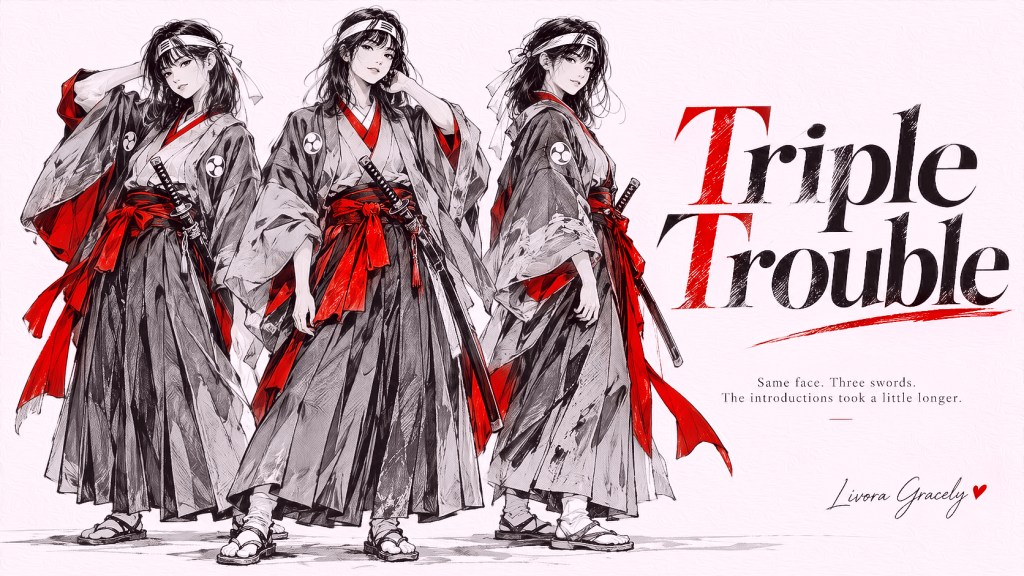
  • Same face. Three swords. The introductions took a little longer.


    “Didn’t I just let you in?”

    The young woman at the gate looked past the keeper’s shoulder.

    “That was my sister.”

    “Then didn’t I just let your sister in?”

    “That was my other sister.”

    The keeper looked down at his register. He had written one name very confidently.

    Three Arrivals

    Inside the courtyard, two women turned toward the gate. The third stepped through to join them, and the keeper discovered that his difficulty had acquired a second difficulty.

    All three wore dark robes, red sashes, and white headbands. Three sheathed swords rested at their sides. The breeze lifted the loose ends of their ribbons, offering no assistance whatsoever.

    “Hana,” he said, pointing at the nearest one.

    “Mei.”

    He pointed at the middle one. “Mei.”

    “Aki.”

    He considered the woman on the left.

    “Please be Hana.”

    “I usually am,” she said.

    His brush hovered above the page. Somewhere inside the hall, wooden practice swords knocked together. The courtyard smelled of damp cedar and freshly swept earth.

    “You weren’t standing there before,” he said.

    “We walk,” Mei explained.

    A Useful System

    The keeper asked them to stand in a row: Hana, Mei, Aki.

    “There. Now nobody move.”

    Mei glanced at the practice hall. “Is that the first lesson?”

    He dipped his brush. A drop of ink fell beside the name he had already written.

    Hana leaned closer. “You have me down as Hama.”

    “I can correct that.”

    “Good. Hama hasn’t brought a sword.”

    While he scraped the extra stroke into something smaller, Aki bent toward the gate. Its lower hinge pin had worked halfway out. She pressed it back into place with her thumb.

    “You may want to check that,” she said.

    The keeper looked up at the gap in his row.

    “Who moved?”

    “The gate,” said Mei.

    Hana turned to her and caught a trailing end of her headband before it brushed the wet register. She tucked it through the knot and pulled gently.

    Now two of them had moved.

    The keeper laid down his brush.

    One at a Time

    “I’m sorry,” he said. “Could we begin again?”

    Mei opened her mouth. Hana touched her sleeve, and she waited.

    “I’m Hana,” said the woman still holding the ribbon. “I arrived first.”

    He looked at her face before writing. This time, he made the name carefully.

    “Hana.”

    She nodded.

    Mei introduced herself next, without adding anything about gates, walking, or the unfortunate Hama. Aki came back from the hinge and waited until he was ready.

    He wrote all three names. Beside Aki’s, he made a small reminder to repair the gate.

    “Thank you,” he told her.

    “It should stay up until then.”

    “A generous improvement.”

    Mei laughed. He looked at her.

    “Mei?”

    “Yes.”

    His shoulders lowered.

    Present

    At the hall door, their instructor called, “Hana?”

    One hand rose.

    “Mei?”

    Another hand.

    “Aki?”

    The third.

    The keeper watched them cross the courtyard. Hana checked the knot she had retied; Aki avoided the loose stone near the steps. Mei turned back and gave him a small wave.

    He returned it, then drew three neat ticks beside the names.

    The instructor looked toward the gate.

    “Any trouble?”

    The keeper glanced at his register.

    “Three,” he said. “All present.”

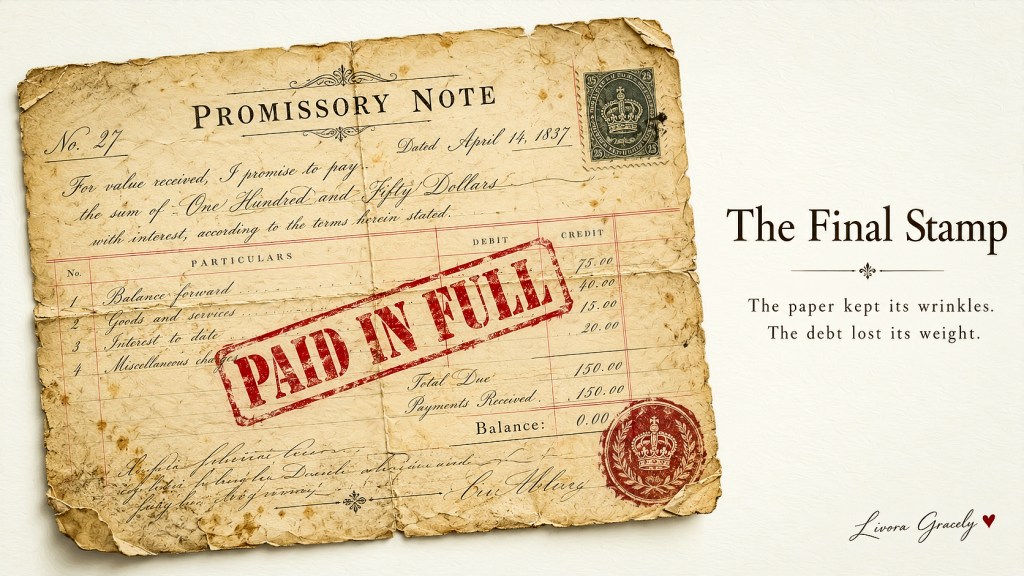
  • The paper kept its wrinkles. The debt lost its weight.


    The red stamp was too large for the space marked Balance.

    Mrs. Finch held it above the promissory note, considering the available room. Across the desk, Mr. Vale watched her hand.

    “Will it fit?”

    “Somewhere.”

    “I’d prefer it on my paper.”

    “That is the usual arrangement.”

    The Last Coins

    His final payment lay in a small stack beside the ledger. Mrs. Finch counted it, moved the coins into her cash box, and ran a finger down the column of earlier payments.

    Mr. Vale kept his hat on his knees. He had come to this desk so often that his thumb found the worn patch on its brim without looking.

    The room smelled of ink and stove ash. Outside, a cart rattled over the stones. Mrs. Finch turned a page, and he straightened in his chair.

    “Is something missing?”

    “The next page.”

    “Ah.”

    She found it. He loosened his hold on the hat.

    The note had travelled folded inside his coat through rain, sawdust, and several winters. One corner had gone soft; another insisted on curling upward. He pressed it flat while she checked the figures.

    “It won’t stay down,” he said.

    “Neither does my drawer.”

    To demonstrate, she pushed the little desk drawer closed. It slid back out an inch.

    Mr. Vale glanced at its crooked runner. Then his eyes returned to the ledger.

    Nothing Remaining

    Mrs. Finch wrote the final payment beneath the others. The pen scratched, paused, and scratched again.

    “One hundred and fifty received,” she said.

    He nodded. He knew the total. He had carried pieces of it here in pockets, envelopes, and once a clean sock when the envelope tore.

    Her pen moved to the last line.

    0.00.

    “There.”

    Mr. Vale leaned forward. “Is that everything?”

    “Everything.”

    He looked at the small round zeros.

    “They don’t take up much room.”

    “Would you like larger ones?”

    “No. Those will do.”

    She pressed the stamp into the ink pad, turned it diagonally, and brought it down across the note.

    Thump.

    PAID IN FULL.

    Mr. Vale’s hand moved toward the paper. Mrs. Finch held up one finger.

    “Let it dry.”

    He sat back. For once, the waiting required no arithmetic.

    The Same Paper

    When she slid the note across, he lifted it by the edges. The stains remained. So did the folds and the corner he had been trying to flatten.

    He read the red words once, then turned the paper slightly and read them again.

    Mrs. Finch closed the ledger.

    “Same day next month?” he asked.

    She looked up.

    He looked down at the stamp.

    “Oh.”

    His hat stayed on his knees a moment longer. Then he put it on, tucked the note into his coat, and stood.

    At the door, he stopped.

    “That drawer,” he said. “I could straighten the runner tomorrow.”

    “You don’t owe me a repair.”

    “I know. It bothers me.”

    Mrs. Finch glanced at the drawer, which had quietly opened another inch.

    “It bothers me too.”

    He smiled. “I’ll bring my tools.”

    “I’ll put the kettle on.”

    He reached for the door handle, then turned back.

    “Must I bring the paper?”

    “Only if you want to show it to the drawer.”

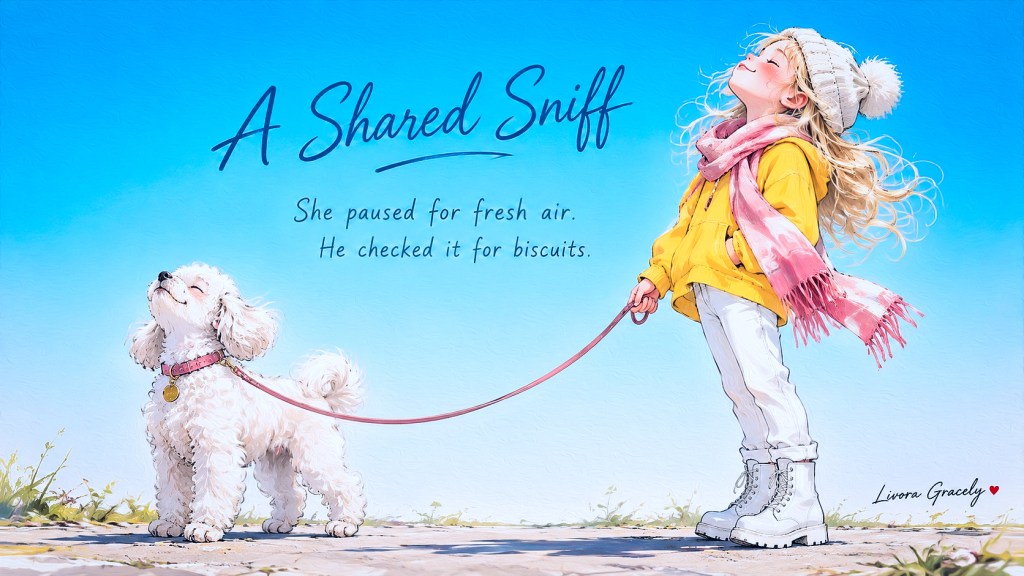
  • She paused for fresh air. He checked it for biscuits.


    On Nora’s walks, a sniff was supposed to take three seconds. Pip had never agreed to this.

    He was still considering the first lamppost when she counted to four.

    “That’s extra.”

    His nose moved an inch to the left.

    “You can’t start again on the other side.”

    Pip started again on the other side.

    Important Information

    The morning air nipped Nora’s cheeks above her pink scarf. Her boots scuffed along the pavement, while Pip’s little brass tag ticked against his collar. At the next corner, a gust lifted his ears and blew a curl across her mouth.

    She tucked it away with a glove. Something small and gritty brushed her fingertips inside her coat pocket.

    “Come on. We’ve hardly gone anywhere.”

    Pip left the lamppost. He inspected a leaf, a drain cover, and the place where the leaf had been before the wind moved it.

    Nora waited with one hand on her hip.

    “Are you reading the whole pavement?”

    He lifted his head at last. She took this as a yes.

    Her Turn

    Beyond the houses, the path opened beside a patch of frosty grass. The wind came cleanly across it, carrying the damp smell of earth and a faint trace of woodsmoke.

    Nora stopped.

    She tipped her face toward the sun and breathed in. The cold reached right to the back of her nose. Beside her, Pip raised his muzzle too, his eyes narrowing beneath the ruffled white curls.

    For a moment, they stood exactly alike.

    “See?” she said. “This is a nice smell.”

    Pip sniffed again. His tail began to move.

    “No investigating. Just enjoying.”

    He stepped closer to her yellow coat.

    Nora turned toward the grass. Pip turned with her. She faced the other way, checking whether the woodsmoke came from the houses.

    Pip followed that way too.

    “It’s not a dance.”

    He sat down beside her pocket.

    A Second Opinion

    Nora put her free hand inside and felt the gritty crumbs again. Beneath them lay two little dog biscuits, wrapped in a folded paper bag.

    Mum had tucked them there before they left.

    “Oh.”

    Pip’s tail swept the pavement.

    “You’ve been smelling my coat.”

    She took out the bag. His eyes opened fully.

    “I thought we were having a moment.”

    Pip remained seated. He was prepared to continue having it.

    Nora crouched and offered him one biscuit. It disappeared with a dry little crunch. She brushed a crumb from his chin, then slipped the folded bag back into her pocket.

    The lead lay loose between them when she stood. This time, she left it that way.

    Fresh Air

    They stayed beside the grass a little longer. Nora breathed in again, letting the sun warm her eyelids. Pip lifted his nose beside her knee.

    “There,” she said. “Now you’re getting fresh air.”

    His nose turned toward her pocket.

    “There’s only one left.”

    Pip sat down again.

    Nora looked at him, then up at the blue sky.

    “Apparently the air needs another minute.”

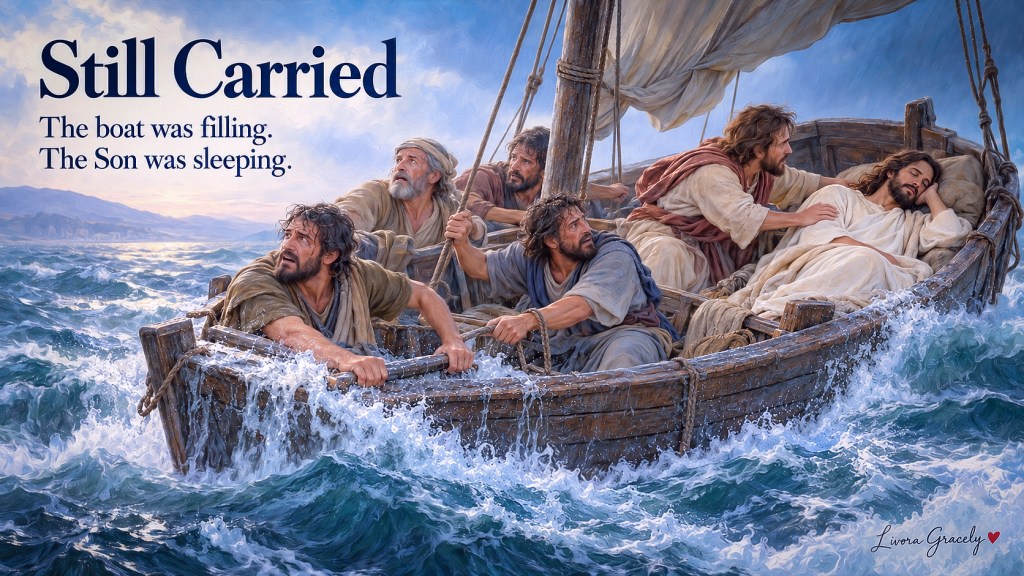
  • The boat was filling. The Son was sleeping.


    Water broke over the side before the boat had recovered from the last wave. The hull lurched beneath the disciples, and cold spray struck their faces. At the stern, Jesus slept on a cushion.

    They woke Him with a question that had become more urgent than the crossing:

    “Teacher, don’t you care if we drown?”

    Mark places their fear beside His sleep. Hebrews brings us closer to the identity of the One they woke. Having called the Son the radiance of God’s glory and the exact representation of His being, it continues:

    “Sustaining all things by his powerful word.” — Hebrews 1:3, NIV

    The Same Son

    The sentence has not changed its subject. The One who makes the Father known is also the One who sustains creation. His relationship with the world reaches beyond what He teaches its inhabitants about God. The world itself depends upon Him.

    This gives weight to everything Hebrews has already said. God speaks by His Son, through whom He made the universe. The Son reveals God faithfully, and His activity extends throughout the creation that came into being through Him. Revelation and sustaining belong to the same Person.

    The disciples approached Jesus as their Teacher. Hebrews gives that title a larger setting. The authority of His teaching belongs to One whose relationship with creation is deeper than theirs. He speaks within a world that owes its existence and continuance to Him.

    There is something difficult to hold together here: the Son’s real participation in human life and the vastness of the claim Hebrews makes about Him. His sleep belongs to the Gospel account. His sustaining belongs to the letter’s description of His identity and work. Neither needs to be removed to make the other easier.

    Still Sustaining

    Creation has a beginning. Sustaining concerns its continuance.

    Hebrews 1:2 has taken us back to the making of the universe. Now the letter speaks of the Son’s continuing activity. The world does not pass beyond His concern once it has been made. Its existence remains dependent upon Him.

    An ordinary maker can finish an object and leave it behind. A table may outlast its carpenter; a vessel may travel where its builder never goes. Hebrews describes a relationship with creation that remains active throughout its existence. The Son continues to uphold what came into being through Him.

    That continuing work is easy to overlook precisely because existence usually feels ordinary. Another morning arrives. A seed opens in the soil. Someone draws breath while deciding what to say. Hebrews asks its readers to understand the familiar world as creation still dependent upon its Maker.

    The letter does not explain the physical mechanism of this sustaining. It tells us to whom creation owes its continuance. Its confidence rests in the Son’s activity, rather than in the appearance that the world can carry on by itself.

    The disciples had to wake Jesus to speak with Him. Hebrews gives us no reason to think their cry began His care for creation.

    All Things

    The reach of the phrase is enormous: all things.

    It includes more than the lives of those who recognise the Son. Creation’s dependence is already real before anyone understands or acknowledges it. The claim extends beyond a congregation, a nation, or a single boat crossing a lake.

    Paul expresses a closely related truth when he writes that all things hold together in Christ (Colossians 1:17). Both passages direct attention to the same Person and to a dependence that reaches throughout the created world.

    This places bodily life within the discussion. Water, earth, breath, and the material conditions of daily existence belong to creation. Hebrews gives no reason to treat them as an unrelated background while the Son attends only to religious matters.

    Yet sustaining creation cannot simply mean keeping every part of it comfortable. The boat in Mark’s account was in genuine danger. The Son’s presence did not prevent the disciples from encountering a storm, and the existence of a storm did not place the lake beyond His authority.

    Hebrews’ claim is larger than a promise of favourable weather. It concerns the dependence of the whole created order upon the Son, including a world in which suffering and danger remain real.

    His Powerful Word

    Hebrews names the means of His sustaining: His powerful word.

    The power belongs to the Son whose word it is. This is no technique handed to human beings for controlling the world through carefully chosen sentences. The letter is describing His authority over creation.

    At the lake, that authority became visible in a particular event. Jesus rebuked the wind and addressed the waves. The storm subsided at His command.

    Hebrews takes our attention beyond that extraordinary moment. The Son’s relation to the world includes its ongoing preservation. The calm of one lake displays His authority; the letter affirms the greater reach of His sustaining work.

    Read beside His appointment as heir of all things, this continuing work also places creation within God’s purpose. Its future belongs with its beginning and continuance in the Son’s hands. We are not given a timetable for every difficulty. We are given the identity of the One upon whom creation depends.

    On the lake, the wind had fallen silent. The disciples were still afraid. They turned to one another with a different question:

    “Who is this?”

    They were no longer asking whether He cared enough to wake.

    They were asking who had been sleeping in their boat.

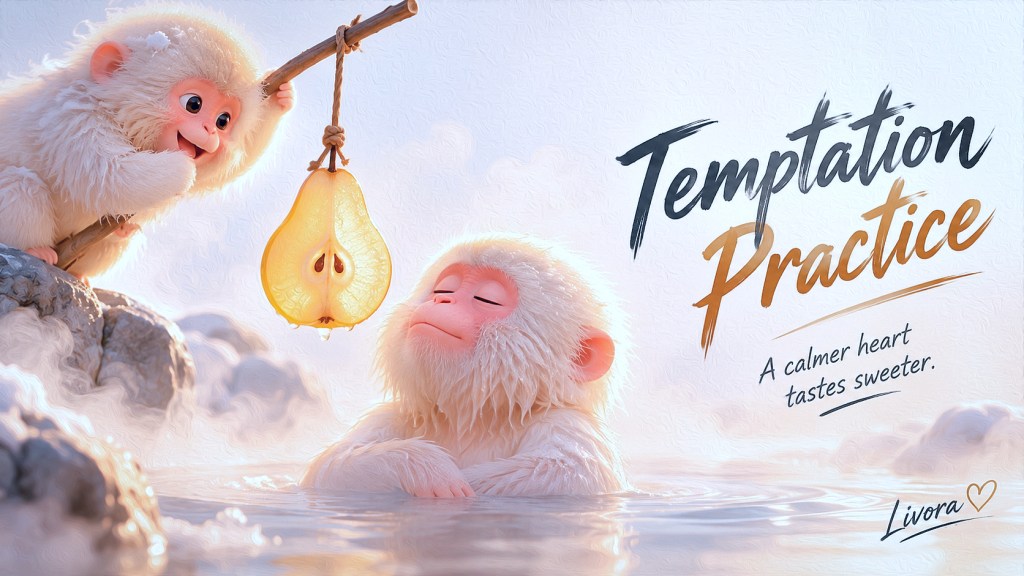
  • A calmer heart tastes sweeter.


    The monkey had been meditating for eleven minutes when the pear arrived. This was unfortunate. Eleven minutes was a personal record.

    He sat chest-deep in the mountain spring, eyes closed, hands resting neatly on the warm stone beneath the water. Steam curled around his white fur, while snow clung to the rocks above him. Somewhere beyond the mist, water trickled steadily down the mountain.

    Plip. Plip. Plip.

    Peace had been achieved. Or something very close to it.

    The Pear

    Then came the smell: ripe pear, sweet and cold in the rising steam.

    His left nostril moved. He corrected it.

    On the rock behind him, his younger brother held a long stick. A loop of string cradled half a pear beneath its tip. Morning light shone through the cut flesh, turning it translucent gold around two dark seeds.

    The younger monkey lowered it until it hung five centimeters from his brother’s nose. The nostril moved again.

    “Inner peace,” whispered the younger monkey.

    His brother said nothing. The pear swung left, then right, while he continued breathing slowly.

    In. Pear.

    Out. Pear.

    In. Definitely pear.

    The younger monkey covered his mouth to stop himself laughing. Then he lowered the fruit another centimeter.

    His brother opened one eye.

    The little monkey froze, holding the stick perfectly still. After a moment, the eye closed again.

    A Tired Arm

    Another minute passed, then two. The little monkey’s arm began to ache. He shifted his grip, and the stick dipped. The pear tipped sideways in its loose loop and slipped free.

    Ploop.

    Both monkeys stared at the fruit floating between them. The younger one laid down the stick and scrambled to the water’s edge. He reached for the pear, then stopped. His older brother had already picked it up.

    The little monkey sighed. The pear had won.

    His brother examined the fruit. Then he pressed his thumbs into the ripe flesh and gently pulled it into two smaller pieces. He held one out toward the rock.

    The little monkey took it and blinked.

    “You wanted it?”

    “Very much.”

    “Then why didn’t you take it?”

    The older monkey bit into his piece. Crunch. Juice ran down his chin as he chewed.

    “I was waiting.”

    “For what?”

    Another crunch.

    “For you to get tired.”

    Beside Him

    The little monkey stared at him through the drifting steam. Then he looked at the piece in his hand and took a bite.

    His brother finished eating and settled back against the warm stone. After a moment, the younger monkey climbed quietly into the spring beside him, holding the last mouthful above the water until he had found somewhere to sit.

    He ate it. His brother closed his eyes again.

    For almost thirty seconds, neither moved. Then the younger monkey whispered,

    “Are we meditating?”

    “No.”

    “What are we doing?”

    The older monkey opened one eye.

    “Digesting.”

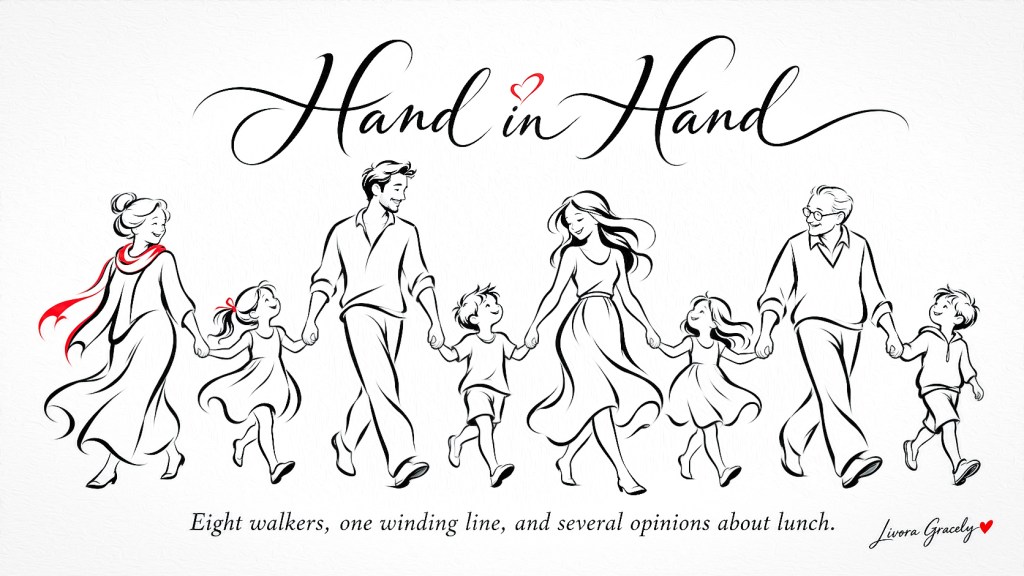
  • Eight walkers, one winding line, and several opinions about lunch.


    Lunch had been delayed by a shoe.

    The shoe belonged to Max, who stood at the end of the family holding Grandpa’s hand and examining his loose lace.

    “It keeps coming undone.”

    “That’s because you’ve tied it into a wish,” Grandpa said.

    He set down his canvas bag and bent to make a proper knot. A paper parcel rustled inside. Max sniffed.

    “Is that lunch?”

    “Emergency supplies.”

    “I’m having an emergency.”

    “You’ve been outside for six minutes.”

    Max considered this. “It’s developing quickly.”

    The Long Table

    They set off again: Grandma, Lily, Dad, Sam, Mum, Rose, Grandpa, and Max. Eight people linked by seven pairs of hands, with Grandpa’s bag swinging from his shoulder.

    The line bent around a lamppost. Grandma’s red scarf lifted in the breeze, and Lily hopped over a pavement crack without releasing either hand. Somewhere ahead, onions sizzled behind an open café window.

    “Pizza,” said Sam.

    “Noodles,” said Lily.

    “Soup,” said Grandma.

    Dad looked along the line. “We’re finding one place.”

    “A very long place,” Mum said.

    Rose tilted her head back toward her. “Can my lunch be a pancake?”

    “You had pancakes for breakfast.”

    “I know. They were good.”

    Behind Grandpa, Max stepped carefully over another crack. His knot held.

    “I vote for something we can reach before dinner.”

    The Menu

    Outside the café, they folded themselves into a loose semicircle around a menu board. Grandpa’s bag brushed Dad’s elbow. Warm bread smelled faintly through the paper.

    Sam found pizza. Lily found noodles. Grandma found soup.

    Dad brightened. “There. Everybody gets what they want.”

    Mum peered through the window. Two small tables were free, one beside the door and one behind a large pot plant.

    “Four here, four there,” Dad said.

    “Which four?” asked Lily.

    “We’ll work it out.”

    Rose squeezed Mum’s hand. “Am I behind the plant?”

    “Only if you’re growing,” said Grandpa.

    Max rose on his toes to inspect the window. “Can the plant sit with the other four?”

    Dad looked at the tables again. He pictured passing Rose’s plate around the leaves, then carrying someone else’s drink across the room.

    “Let’s keep walking.”

    Grandma glanced at Grandpa’s bag. “How far do you think your emergency supplies will stretch?”

    “Depends how much everybody argues before the first bite.”

    Eight Places

    At the little park, Grandpa opened his bag beneath a tree. The folded picnic blanket came out first, followed by sandwiches, oranges, and a flask of water.

    “You brought a whole lunch,” Dad said.

    “I’ve walked with this family before.”

    Mum spread the blanket over the grass. Its corners curled until the children put their shoes beside them. Dad sat down, then shifted his knee so Lily could settle next to Grandma. Sam moved the sandwiches into the middle, where everybody could reach.

    Rose patted the space beside her for Max. He dropped onto it with a sigh normally reserved for people returning from the mountains.

    “Made it.”

    The grass smelled damp beneath the blanket. Paper crackled as Grandpa opened the parcels; a little mustard had escaped onto one corner.

    Grandma took that sandwich.

    “Mine’s trying to leave.”

    “Hold it firmly,” said Max. “We’ve walked far enough.”

    Any Objections?

    For a while, the only discussion concerned who had taken two orange pieces and whether two halves counted as one sandwich.

    Dad leaned back on his hands. “So. Is everybody happy with lunch?”

    Sam nodded with his mouth full. Lily offered Grandma another napkin. Rose was peeling a corner of crust from her sandwich and placing it neatly beside her shoe.

    “No pizza complaints?” Dad asked.

    Sam swallowed. “I’m still thinking.”

    Grandpa lifted the last wrapped sandwich from the bag.

    “Anyone want this?”

    Sam’s hand went up.

    “Thinking makes me hungry.”

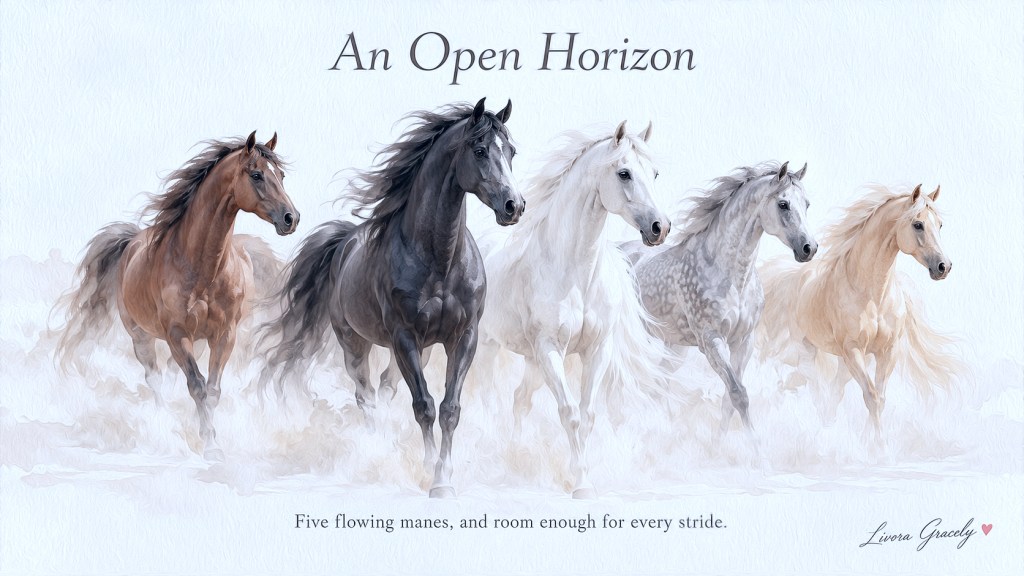
  • Five flowing manes, and room enough for every stride.


    Pffft.

    The palomino spat out a mouthful of mane. The other four horses were looking toward the horizon, which was where she would have looked too, given access to her face.

    “Ready?” asked the black horse.

    “Nearly.”

    She shook her head. The wind put everything back.

    The Starting Line

    They stood on the rise above the meadow: chestnut, black, white, dapple-grey, and palomino. Dew chilled their hooves. Beyond the slope, the grass turned silver wherever the breeze passed over it, and a low white stone marked the far end of the field.

    “To the stone,” said the black horse. “All together.”

    He took one step forward. The chestnut matched him. The white horse followed, while the grey edged sideways to avoid a thistle.

    “Straight line,” said the black horse.

    The grey returned to the thistle.

    The palomino flicked her forelock aside and looked along the row. “Is this a race?”

    “A morning run.”

    “Then why are you already winning?”

    He looked down at his forefeet and moved them back.

    Five Across

    They set off with a rustle of grass, then the heavier drumming of hooves on the dry slope. The chestnut’s mane streamed behind him. The grey shook off the last beads of dew, scattering them against the white horse’s neck.

    The black horse lengthened his stride.

    Beside him, the white horse did the same. The chestnut drew closer on his other side, and the grey moved inward around a patch of nettles. For several strides, five tails lifted and five sets of hooves carried them downhill.

    Then the palomino dropped behind.

    “Keep up,” called the black horse.

    She moved left. The grey was there. She tried right and found the white horse’s flying tail.

    Pffft.

    This time the hair was not even hers.

    The black horse slowed to a trot. The others slowed with him, warm breath blowing through their nostrils. Behind them, the palomino emerged with her ears flattened.

    “Shorter steps?” he suggested.

    “Wider horses,” she said.

    He looked at the white horse, then at the grey. There was scarcely a hoof’s width between them.

    “Wider gaps,” she corrected.

    Room to Run

    The black horse stepped sideways into unmarked grass. The chestnut moved farther out, and the grey found a clear stretch beyond the nettles. The white horse waited while the palomino came alongside.

    “Here?” asked the black horse.

    She stretched one foreleg, then the other. Her tail swung freely.

    “Here.”

    This time, he waited for her first step.

    They climbed into a gallop. The ground struck firmly beneath them; cool air rushed over their eyes and through their manes. The black horse glanced sideways once. The palomino was still there, running with her nose clear of everyone else’s tail.

    Ahead, the white stone rose above a clump of dandelions.

    She reached it first.

    At the Stone

    The black horse pulled up beside her, breathing hard.

    “I thought you said it wasn’t a race.”

    The palomino lowered her head and bit off a dandelion.

    “It wasn’t.”

    The chestnut arrived. Then the white horse and the grey, who had gone around another thistle on principle.

    The black horse looked back across the broad meadow. Their tracks spread all the way to the rise.

    Beside him, the palomino chewed.

    “You were in a hurry, though,” he said.

    She swallowed and nosed the remaining flowers toward him.

    “Breakfast.”

    He inspected the dandelions. Then he lowered his head.

    The grey pushed between them.

    “Now it’s a race.”

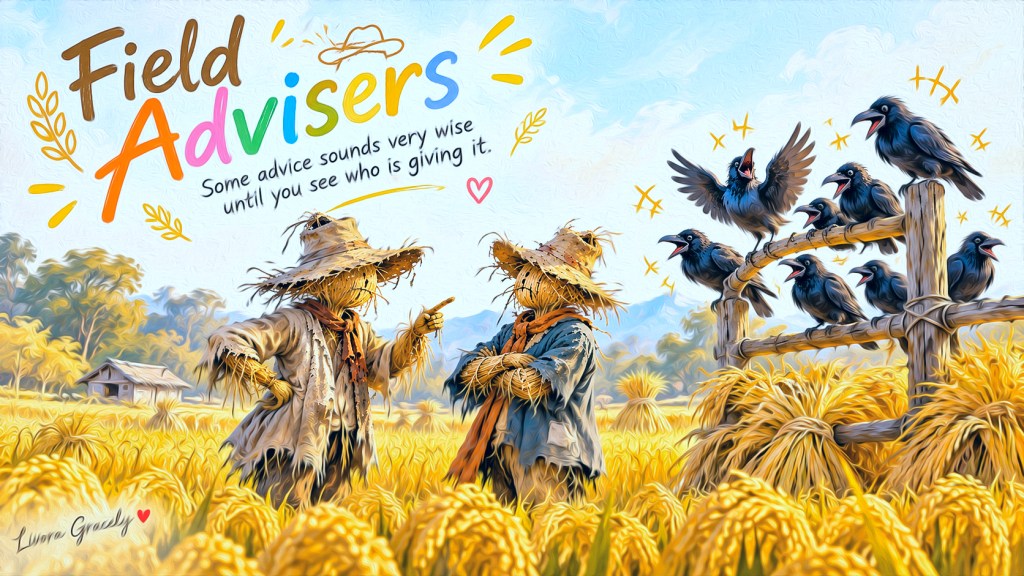
  • Some advice sounds very wise until you see who is giving it.


    The left scarecrow lowered his voice. Every crow on the fence leaned closer.

    “We have a security problem.”

    The right scarecrow looked at the fence. A black beak disappeared briefly beneath a wing.

    “Yes,” he said. “I can see it.”

    “We need expert advice.”

    The beak reappeared.

    A Larger Hat

    Morning warmth had begun to reach the rice. Heavy golden heads brushed the scarecrows’ trousers, and the breeze carried the dry, dusty smell of straw beneath their collars. Neither had moved from his stake since April. The left one’s coat had, however, lost two buttons and most of an elbow.

    “A commanding presence,” he said, lifting his remaining elbow. “That’s what we’re missing.”

    “Your hat’s folded at the back,” said the right scarecrow.

    “Precisely. It should be larger.”

    “I meant—”

    “Excellent suggestion.”

    The crow on the highest post nodded. “A wide brim. Very important.”

    The left scarecrow turned toward him.

    “You understand these things?”

    “I’ve seen a great many scarecrows.”

    This was difficult to dispute.

    With some assistance, the folded brim was spread outward. Straw scratched against straw. A thread snapped. The right scarecrow held the edge while his colleague pushed the crown into what he considered a more authoritative shape.

    Below them, the hat’s shadow widened across the rice.

    Two crows hopped down from the fence.

    Field Experience

    “Better,” said the crow on the post.

    The left scarecrow tried a stern expression. His stitched mouth made limited adjustments.

    “And we should change positions each morning.”

    The right scarecrow glanced at the stake running through his trousers.

    “Perhaps every Tuesday,” the left one added.

    A choking sound travelled along the fence. One crow opened both wings; another gripped the rail until the shaking stopped.

    “They’re nervous,” the left scarecrow whispered.

    His colleague watched a third bird drop into the rice. The stalks stirred beneath the widened brim. A soft crack came from somewhere near their feet.

    “We could ask the farmer about bells,” he said.

    “Unnecessary noise,” said the crow above them. “A quiet field is far more dignified.”

    The left scarecrow nodded. “I was thinking exactly that.”

    The right one looked down again.

    “What?” asked his colleague.

    “Come a little this way. Just your head.”

    Beneath the Brim

    The left scarecrow leaned as far as his stake allowed. His hat brushed the other one’s shoulder.

    Under its broad shadow, a crow stood on a bent rice stalk with a grain between his beak. Another was already choosing the next head.

    The first swallowed.

    “Much cooler,” he said.

    Above them, the expert inspected a feather.

    The left scarecrow stayed bent for a moment. Then he straightened and reached for his brim.

    “Could you fold it back?”

    His colleague did. He tucked the broken thread beneath the band and pressed the crown into place without mentioning its authority.

    “You were saying something about bells?”

    “Yes.”

    “Tell me.”

    One More Recommendation

    By afternoon, the farmer found both scarecrows facing the path. One sleeve flapped toward the fence; the other pointed to the grain husks beneath their stakes.

    The crows watched from the rail, rounder than they had been that morning.

    “Before you make any changes,” called their expert, “we recommend another meeting.”

    The left scarecrow looked toward his colleague first.

    “Tomorrow?”

    “After the farmer’s been.”

    The expert stopped arranging his feathers.

    “We may be unavailable.”

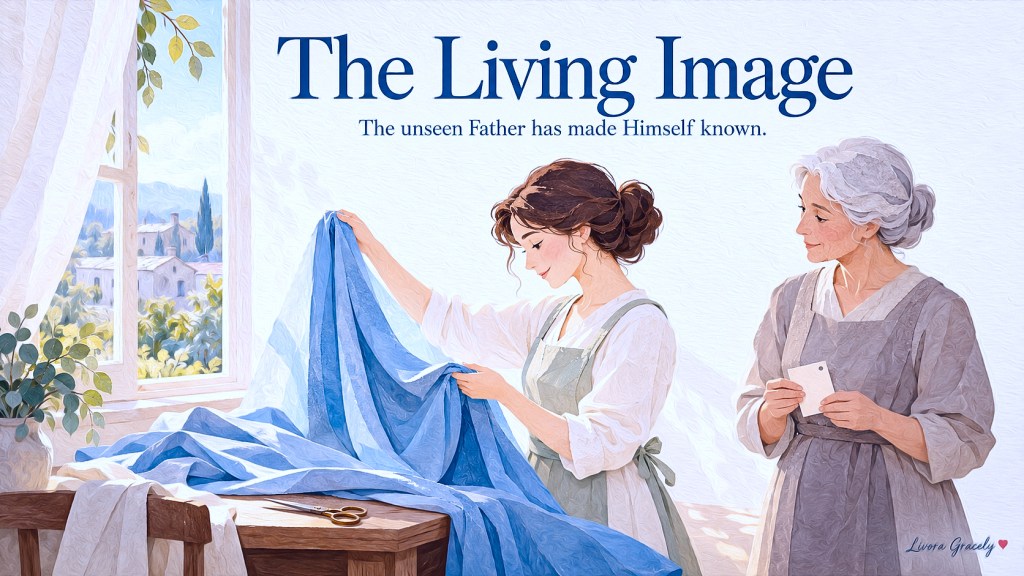
  • The unseen Father has made Himself known.


    “Try it by the window.”

    The young seamstress looked down at the cloth she had labelled grey. Her older colleague moved a pair of scissors aside and waited while she carried it across the workroom. The fabric whispered against her apron. Near the open window, the air smelled of rain from the courtyard below.

    She lifted one corner into the daylight. Blue appeared along the fold, then across the length of fabric resting over her arm.

    Behind her, the older woman quietly set a fresh label beside the pencil.

    Hebrews has already told us that God speaks by His Son. Now it brings us closer to the One through whom He speaks:

    “The Son is the radiance of God’s glory and the exact representation of his being.” — Hebrews 1:3, NIV, opening clause

    The Father’s Glory

    The words are familiar enough to pass over quickly. Yet Hebrews has moved beyond describing someone entrusted with a message. It is describing the Son Himself.

    He is the radiance of God’s glory.

    In Scripture, God’s glory sometimes becomes visible in light, cloud, or fire. But glory reaches deeper than brightness. It concerns the weight of who God is: His holiness, majesty, goodness, and power. A dazzling appearance alone would tell us very little if it revealed nothing of the One whose glory it bears.

    Hebrews joins the Son directly to that glory. He does not stand outside it, pointing toward something He has only heard about. The glory belongs to God, and the Son is its radiance.

    This gives another depth to the words spoken through Him. The prophets faithfully carried God’s words. The Son reveals the One whose words they carried. His place cannot be measured simply by how much information He brings.

    The Father has opened more than a conversation.

    He has made Himself known.

    The Radiance

    Radiance speaks of brightness shining forth. In Hebrews, the glory belongs to God and is made known in the Son.

    Hebrews does not describe the Son as someone who has collected a few impressions of God and assembled them into a convincing account. It names Him the radiance of God’s own glory. His revelation of the Father belongs to who He is.

    The sentence is also careful to keep the Father and the Son before us. The glory is God’s; the Son is its radiance. Their relationship is intimate, yet the writer continues to speak of both. The Father does not disappear when the Son is revealed.

    Nor does the language require a physical glare. Hebrews is not asking its readers to imagine a face so bright that nobody could look at it. The claim reaches beyond what eyes can bear. In the Son, God’s glory is truly disclosed.

    At the workroom window, the seamstress turned the cloth slowly. The upper fold had warmed in the sunlight; the length hanging against her wrist was still cool. She looked back at the label on the table, then reached for the pencil.

    The Exact Imprint

    Alongside the Son’s radiance, Hebrews affirms the exactness with which He reveals God’s being.

    The word behind representation carries the idea of an imprint, like the distinct impression left by an engraved seal. The lines of the seal remain recognisable in the mark it leaves. In Hebrews, that exactness concerns God’s being.

    The Son does not give a rough likeness of the Father, with important features blurred or missing. He reveals Him faithfully. The word exact leaves no room for a portrait that becomes less trustworthy when examined closely.

    This is more than a resemblance between faces. Hebrews is not describing the shape of the Father’s eyes or explaining how two members of a family might share the same expression. It is speaking about who God is.

    Together, the two expressions carry remarkable weight. Radiance speaks of glory made manifest. Exact representation speaks of the faithfulness of that revelation. The Son truly reveals God because His relationship to God reaches into His very being.

    The letter has taken us far beyond an unusually gifted messenger. It places the Son in a relationship with God that no earlier prophet was given in its opening words.

    The Father Known

    John expresses this mystery in another way: the Son, who is Himself God and is in closest relationship with the Father, has made Him known (John 1:18).

    Later, Philip asks Jesus to show the disciples the Father. Jesus answers that whoever has seen Him has seen the Father (John 14:9). He continues by speaking of the Father in Him and Himself in the Father. The relationship remains; the revelation is real.

    The Son makes the Father known from within that relationship. His words and works reveal the Father with whom He lives in communion. The Father remains present; the Son’s revelation is faithful to Him.

    The radiance and the exact imprint belong together. God’s glory shines in the Son, and God’s being is faithfully revealed in Him. His goodness is not blurred in the telling, nor His holiness softened into something easier to accept. What the Son reveals of the Father can be trusted.

    In the workroom, the seamstress crossed out grey and wrote blue. Her colleague glanced at the new label and drew the scissors closer. Together they spread the cloth beside the window and smoothed its folds. The older woman held the far edge while the younger made the first cut. The blades gave a low rasp as they travelled through the fabric.

    When the piece was laid aside, her colleague reached for the next length of cloth. The seamstress took it from her, leaving the pencil on the table.

    “A moment,” she said.

    The next piece went to the window first.